


2026 Electric Rates

Central Electric, like many utilities, is facing rising costs to purchase and deliver electricity. Our power suppliers (East River Electric, Basin Electric and Western Area Power Administration) are also dealing with higher costs to produce and move power across the grid.

A cost-of-service study was conducted to determine the appropriate rate structure. It is estimated that increases to wholesale power rates and operational costs will add $3.1 million to Central Electric’s expenses in 2026. This will result in rate adjustments across all rate classes effective Jan. 1, 2026.

Specific rate policies can be viewed at the bottom of this webpage. 

Why Are Rates Changing?

  • Inflation and supply chain challenges have made everything from transformers to poles more expensive.
  • Existing members are using more electricity across the state and region. This requires Basin Electric to build more generation and transmission assets, which have much higher costs to build and operate today as compared to existing resources.
  • Central Electric and its power suppliers are investing in reliability through the replacement of aging power lines and equipment.

Why Did the Facility Charge Go Up?

  • With the cost to provide electric service increasing, Central Electric must collect additional revenue through the facility charge.
  • The facility charge supports the cooperative’s fixed expenses to provide electric service. This includes costs to maintain power lines, transformers and electrical equipment.
  • No matter how much electricity a member uses, there are fixed costs to provide electric service.

What is the Demand Charge for General Service Members?

A demand charge of $1 to $2 per KW has been added to general service rates. This charge is based on the highest amount of electricity a member uses during any 15-minute period throughout the month. Members who require more capacity will contribute more through the demand charge.

  • Using a lot of electric equipment at once = higher demand
  • Spreading out the use of electric equipment = lower demand

The cost-of-service study determined that a demand charge is the fairest way for Central Electric to recover infrastructure costs for members who require greater capacity. Download the SmartHub app to monitor energy usage. To read more about demand, visit www.centralec.coop/demand

What Is the Co-op Doing to Control Costs?

  • Central Electric is working collaboratively with electric co-ops across the region to achieve the lowest cost options for generating and delivering power to our members.
  • Central Electric is operating efficiently, managing expenses responsibly and taking advantage of partnerships with neighboring co-ops, suppliers and contractors to minimize costs.

What Can Members Do?

  • Utilize the SmartHub app to monitor energy usage.
  • Manage how you use appliances and electric equipment to minimize the monthly demand charge.
  • Ask about energy efficiency rebates, load management and budget billing options to help manage monthly costs.

The table below shows monthly rate comparisons from 2025 to 2026. Adjustments have been made to the facility charge and energy rates. A demand charge of $1 to $2 per KW has been added to general service rates. Rate adjustments across all rate classes take effect on Jan. 1, 2026. 

Most members are subject to the Residential Single-Phase Policy 800 Rate.

Rate Comparison 2026


As a not-for-profit cooperative, Central Electric Cooperative's rates are designed to cover the cost of providing service. The following list does not include all of the cooperative's available rates.

Policy 800 applies to most members. To discuss your individual rate, please contact our office.


2026 Electric Rate Policies: 

Policy 800 General Service - Single Phase 2026
Members that have single phase farm, residential, seasonal and commercial services for all uses up to 50 KVA.

Policy 801

General Service – Three Phase 2026
Members that have three phase farm, residential, seasonal and commercial services for all uses up to 50 KVA of installed transformer capacity.

Policy 802

General Service-Single Phase Residential Congested Area 2026
Members in towns, suburban areas and other platted congested areas wherein one hundred or more lots are receiving service from the Cooperative for all uses up to 50 KVA of installed transformer capacity.

Policy 804

Electric Heat 2026
Members that have single-phase and three-phase farm, residential, seasonal and commercial services for separately metered heating. 

Policy 805

General Service – Irrigation 2026
Members that have irrigation pivots and pumping station services at secondary voltages.

Policy 820

Renewable Energy Credit (REC) Program 2026
All Central Electric Members are eligible to purchase RECs. This is a rate for members to purchase RECs and establish the qualification criteria and rate for the sale of RECs. Contact our office for more information.

Policy 840 Small Commercial - Single Phase Demand 50-250 KVA 2026
Members that have single-phase farm, residential, seasonal and commercial services for all uses from 50 – 250 KVA of installed transformer capacity.


About Your Meter

Ensuring our members are accurately billed for the energy they use is as important as providing safe, reliable electric service.

Central Electric uses AMR (automatic meter reading) meters, which are read automatically and remotely each day. The meter reads then flow into Central Electric's meter data management system that processes them, then sends them to our website, where our members can access their account information 24/7 on SmartHub. The data also goes to our billing system, which generates each member's bill on a monthly basis.

How We Calculate Your Bill
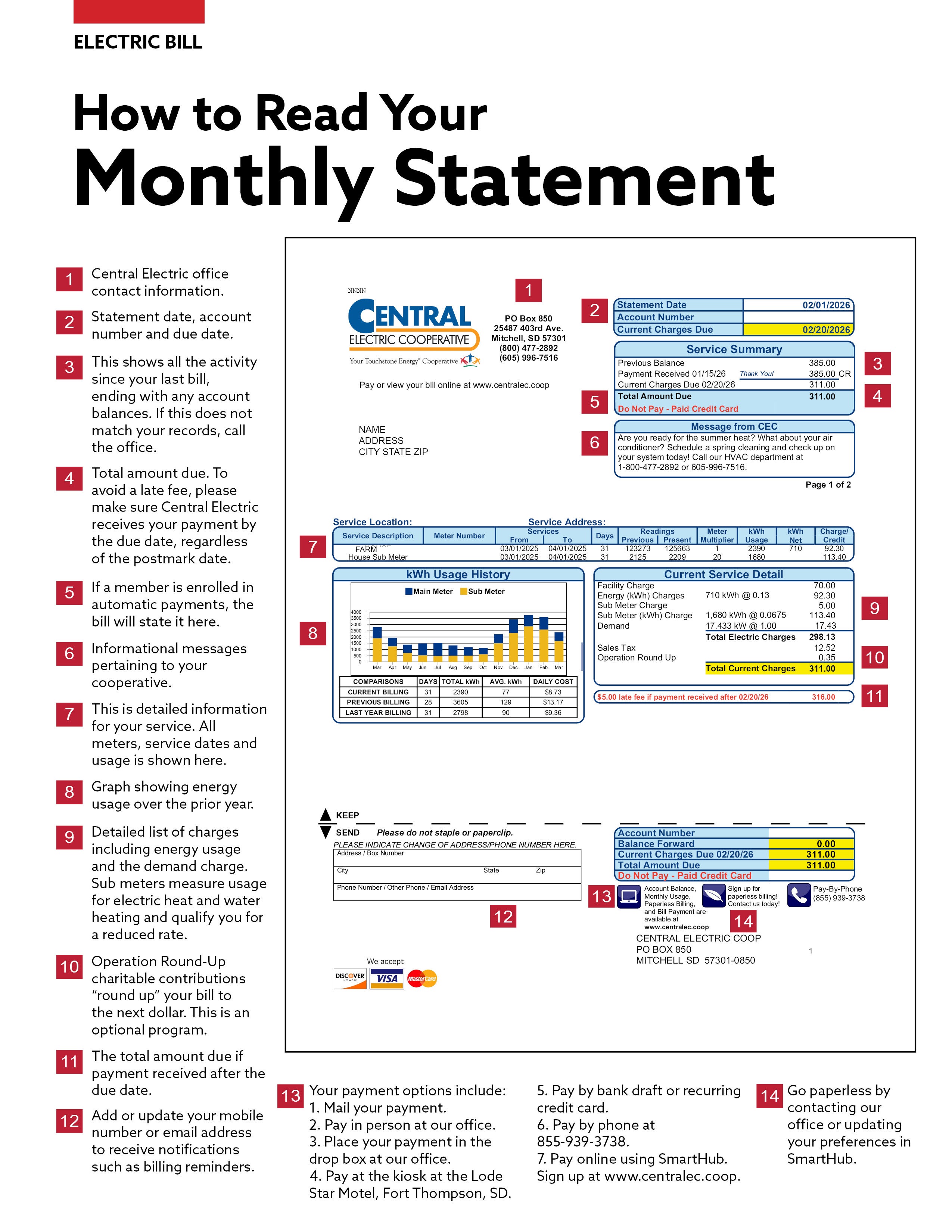
 

Sample Bill